Questionnaires age. Risks don't.
A supplier questionnaire is a snapshot. Between two assessments the risk situation changes — new vulnerabilities, leaked credentials, sanctions, subcontractor outages. Static lists don't reflect that.
Point-in-time, not continuous
Assessments show one moment — not what changes afterwards.
Scores without context
A risk score without links to processes and dependencies says little about the real business impact.
Regulatory pressure
NIS2 and DORA require traceable, ongoing third-party risk management.
The entire TPRM lifecycle in one platform.
From onboarding through assessment and monitoring to remediation and reporting — with cyber intelligence built in.
Central third-party inventory
A consistent overview of your relevant suppliers, service providers and partners.
Criticality & tiering
Differentiate third parties by their importance for data, systems, processes and regulation.
Third party risk assessments
Steer assessments and evidence risk-based instead of a one-size-fits-all approach.
Continuous monitoring
Detect changes in the risk situation even between regular assessments.
Cyber threat intelligence
Complement self-disclosures with external risk signals and publicly available evidence.
Dark web & breach intelligence
Detect indications of compromised credentials and relevant threat signals.
Value chain & dependency mapping
Understand which third parties are connected to which processes and dependencies.
Compliance controls
Map requirements structurally to relevant frameworks and regulations.
Risk & remediation management
Prioritise findings and make responsibilities and measures traceable.
Audit trail & reporting
Document assessments, changes and decisions centrally and audit-proof.
See what your third parties really do.
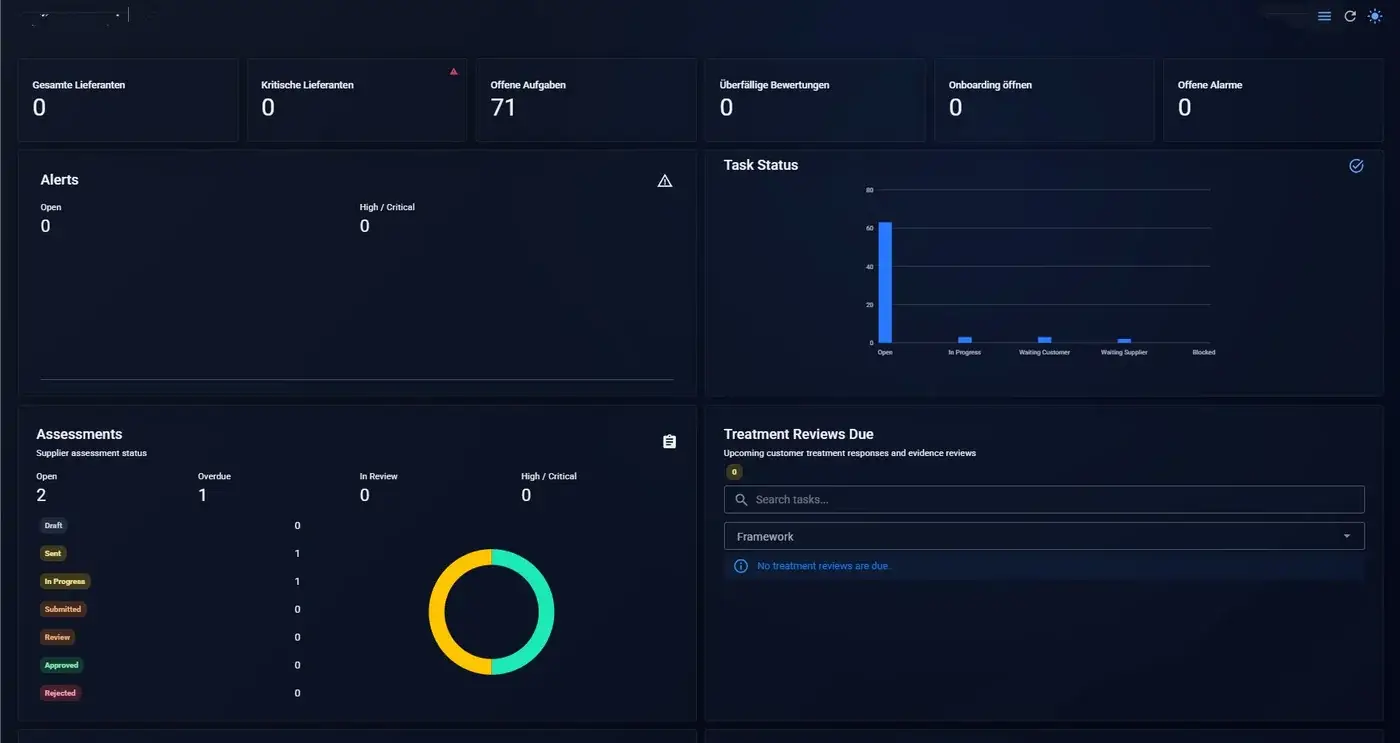
Risk maps, dependency visualization, AI evidence and framework controls — the platform behind apascope TPRM.
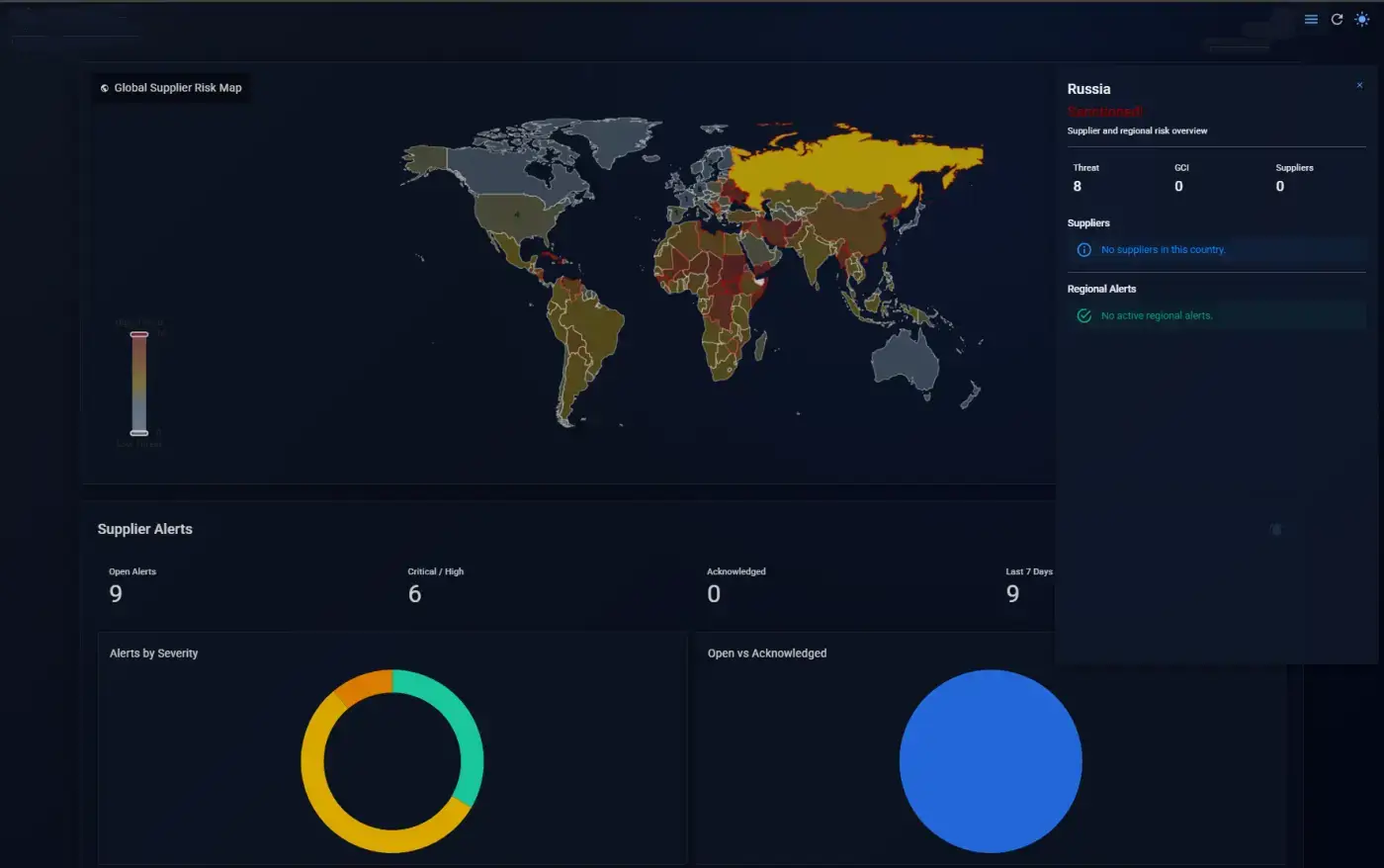
Worldwide threat map with threat scores and sanction lists — per country in real time.
Seven steps, one continuous process.
Onboard the third party
New suppliers and service providers are captured centrally and mapped to master data, services and responsibilities.
Pre-sort the risk
An initial risk classification helps decide how much assessment and monitoring depth is needed.
Perform due diligence
Critical third parties are assessed in a structured way — requirements and evidence follow the actual risk profile.
Monitor actively
TPRM does not end at onboarding: relevant suppliers are continuously observed and new risk signals surfaced early.
Re-assess risks
If the threat situation changes, a structured re-assessment can follow.
Escalate & remediate
Critical findings are prioritised. Owners initiate measures, accept risks or trigger an escalation.
Document decisions
The entire lifecycle stays traceable — from the first assessment to offboarding.
TPRM that grows with the risk.
Continuous, not point-in-time
Complement periodic assessments with current risk signals and ongoing monitoring.
Business context, not isolated scores
Link third parties to critical processes and dependencies to see the real business impact.
Cyber intelligence built into TPRM
Use external evidence, cyber risk signals and threat intelligence as an additional basis for decisions.
Scale risk-based
Focus your resources on third parties and findings with high relevance.
Structured NIS2 & DORA support
Create traceable processes, controls and evidence for your supply chain and third-party risk management.
Auditable documentation
From assessment through measures to risk acceptance, the decision path stays traceable.
Data protection & sovereignty
A solution focused on European (and German) data hosting and GDPR-compliant processing.
Frequently asked questions about Third Party Risk Management
What is Third Party Risk Management?
Third Party Risk Management (TPRM) is the systematic process of identifying, assessing, managing and monitoring risks that arise from external vendors, suppliers, service providers and other business partners. Depending on the organisation, it can cover cyber, operational, regulatory, financial, data protection, geopolitical and concentration risks.
What is the difference between TPRM and Vendor Risk Management?
The terms are often used synonymously. Vendor Risk Management focuses more strongly on suppliers and vendors. Third Party Risk Management is broader and can cover all relevant external parties — from suppliers and SaaS providers to outsourcing partners, consultants and other service providers.
What is a Third Party Risk Assessment?
A Third Party Risk Assessment evaluates the risks of an external party. Scope and depth should follow its criticality and inherent risk. It can consider information security, data protection, business continuity, access rights, regulatory requirements, subcontractors and cyber risks.
Which third parties should be captured?
In principle, all third parties whose failure, compromise or misconduct could have relevant effects on your company. Particular attention is needed for vendors with access to sensitive data or systems, cloud and SaaS providers, outsourcing partners and vendors supporting critical business processes.
Why are supplier questionnaires alone not enough?
A questionnaire captures a vendor’s self-disclosure at a specific point in time. The risk situation can change afterwards. Continuous monitoring and external risk signals therefore complement classic assessments with a dynamic perspective.
How often should third parties be re-assessed?
Risk-based. Critical third parties usually need more intensive monitoring than low-risk suppliers. In addition to regular re-assessments, relevant events or changes should also be able to trigger a re-assessment.
What role does TPRM play in NIS2?
The security of supply chains and direct vendors is an important part of the NIS2 risk-management requirements. Structured TPRM helps identify relevant third parties, assess risks traceably, document measures and observe changes continuously.
What role does TPRM play in DORA?
For financial companies, managing ICT third-party risk is a central part of DORA — including transparency over ICT providers, assessment of critical or important functions, contractual requirements, ongoing monitoring and exit strategies.
What should TPRM software be able to do?
It should support the full lifecycle: a central third-party inventory, criticality assessment and tiering, assessments, evidence management, remediation tracking, continuous monitoring, risk aggregation, reporting and traceable documentation. TPRM becomes especially powerful when current cyber intelligence and business context feed into the risk assessment.
What are fourth-party risks?
Fourth parties are subcontractors or further parties that your direct third parties depend on. Especially in cloud, SaaS and outsourcing models, a failing or compromised subcontractor can indirectly affect your own business processes too.
Make your third-party risks visible.
Let's explore together how apascope TPRM fits your processes — NIS2- and DORA-ready, with data in Europe.
Get in touch